
100 Years of the Austrian Province
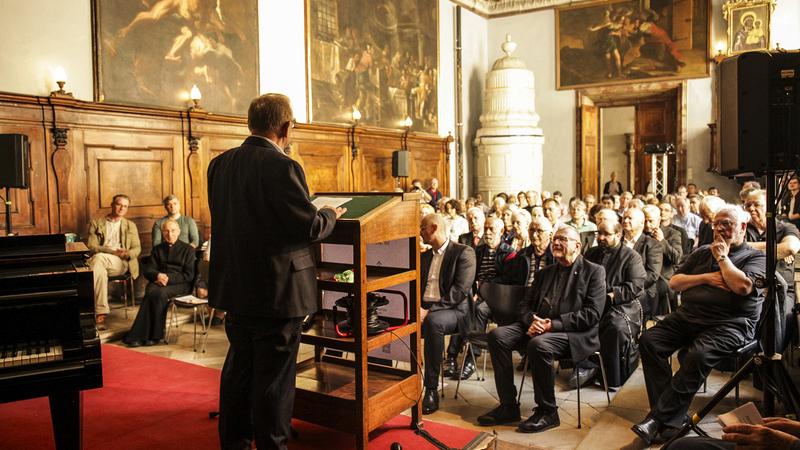
The summer dining hall was packed to capacity, and Provincial Father Josef Wonisch SDS welcomed over 100 guests who joined the Salvatorians in celebrating their first 100 years.
Superior General Fr Milton Zonta SDS, Secretary General Fr Agustín Van Baelen SDS and General Consultor Fr Joseph Rodrigues SDS had travelled from Rome to celebrate with their Austrian confreres. They were accompanied by a number of young Salvatorians from the Tor de' Cenci international formation house, founded in 2017. Guests of honour included the Provincial of the German Province, Fr Friedrich Emde SDS, and the Superior of the newly established Mission Vicariate Pancratius Pfeifer, Fr Piet Cuijpers SDS.
Presentation of the anniversary book “Erweckte Begeisterung”
Following the humorous welcome by the Provincial Vicar, Fr Leo Thenner SDS, who also served as the entertaining host for the day, the first highlight was presented. Provincial Father Josef Wonisch SDS officially presented the anniversary book, entitled "Erweckte Begeisterung" (“Awakened Enthusiasm”), to Superior General Father Milton Zonta SDS.
The work is the result of intensive research initiated and carried out by the editors: the Order’s historian, Fr Peter van Meijl SDS, the Order’s archivist, Robert Passini, and the writer Martin Kolozs. “When compiling the book, care was taken to ensure that it was not only members of the Order who contributed,” said Martin Kolozs, who briefly presented the book to the guests. The book was also produced in close collaboration with numerous external experts and researchers who offer a critical, objective and contemporary perspective on the history, present and future of the Salvatorians. Thanks to their many contributions, new areas have been explored, and previously unknown facts, aspects and perspectives have been brought to light from the archives. “We are now presenting the results of this three-year study of the Order’s history in this volume, comprising 42 articles,” said co-editor Martin Kolozs.
Two short presentations clearly demonstrated the depth of the authors’ engagement with the Austrian province.
Fr Johannes Blum and Communism
The historians Hermann Brugger and János Fehéregyházy have researched the life of Father Johannes Blum SDS (1904–1995), who served as Provincial Superior of the Pro-Province of Romania in Timișoara during the communist era. Blum had been under surveillance by the secret service since 1951. The two authors consulted the archives of the Securitate secret police and examined around 650 items (surveillance reports, reports on house searches, wiretap transcripts, transcribed and withheld correspondence, printed materials and photographs). The result is a vivid portrait of a religious brother who had to guide his province through extremely turbulent times and circumstances.
The Salvatorians as custodians of the Barnabites
Karin Mayer, Head of the Culture and Documentation Department at the Austrian Conference of Religious Orders in Vienna, explored in her lecture the legacy of the Barnabite Order in Austria under the care of the Salvatorians. After the Barnabites were forced to withdraw from Austria, the Salvatorians were entrusted with their duties and their establishments in 1923. What is more, the Salvatorians not only expanded their pastoral outreach through the Barnabite houses, but also took on the responsibility of protecting the valuable cultural heritage of another order and preserving it for future generations. With dedication and confidence, they accepted this immense challenge – a challenge that continues to this day. Through their tireless efforts, the Salvatorians not only saved a religious order’s valuable cultural heritage but also preserved a spiritual legacy from disappearing. This passion for serving art and culture remains evident among the Salvatorians to this day. It is also a service to humanity that serves as spiritual nourishment for the future.
Salvatorian Research Institute
After looking back at the past, Secretary General Fr Agustín Van Baelen SDS turned his attention to the near future – and presented a project that the Salvatorians are currently bringing to fruition: a Salvatorian research institute.
This initiative, launched by the Austrian Pro-Province, is based on the recognition that it is important to intensify research into Salvatorian history and spirituality within the Society. The aim of the new institute is to contribute to this.
“In Western Europe, the number of German-speaking confreres is dwindling,” notes Fr Agustín realistically. “Yet our founders’ sources are either in German or Latin. At the same time, we have many young Salvatorians from Asia and Africa who, unfortunately, do not have access to the language, and that means they do not have access to the sources either. That is why, in future, we want to offer young Salvatorians – both men and women – the opportunity to train so that they can gain access to our historical sources, enabling them to express and convey, in today’s language, what was important to our founder in the beginning.” The idea was spearheaded by the Austrian Pro-Province and the Pancratius Pfeiffer Mission Vicariate. The centre will have two locations: Vienna and Gurtweil. In Vienna, the focus will be on academic research, whilst Gurtweil is intended to serve as the institute’s spiritual centre. The founder’s birthplace will become a venue where, amongst other things, workshops can be held to deepen understanding of the founder’s spirituality and charism.
Thanks to close links with the University of Vienna, students at the Salvatorian Research Institute will be able to obtain a degree in Church History from the University of Vienna or pursue a PhD on a Salvatorian topic. The official announcement will be made by Superior General Fr Milton Zonta during the celebrations.