
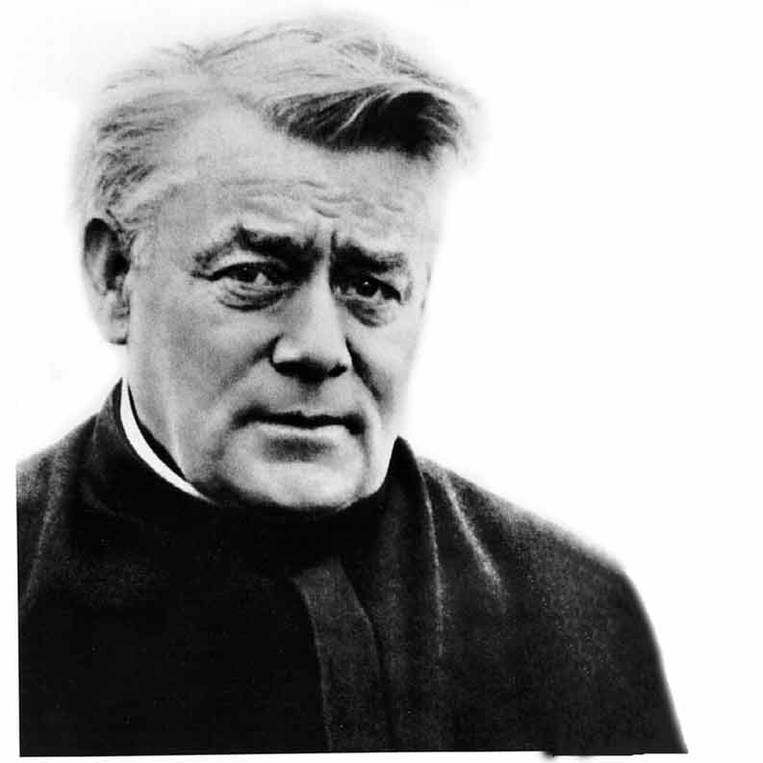
Father Franziskus Maria vom Kreuze Jordan
Childhood and Youth
Franziskus Jordan was born on 16 June 1848 in Gurtweil, Baden, as Johann Baptist Jordan. He grew up in very humble and poor circumstances. As a schoolboy, he was gifted but not particularly hard-working, and always up to mischief. His father died when he was still young, which plunged the family into serious financial difficulties. However, this formative experience changed him profoundly: he became quieter, more thoughtful – and from an early age, Jordan developed the desire to become a priest. As his family were initially unable to afford his higher education, he began an apprenticeship as a painter and decorative painter, and at times also worked on railway construction projects. It was only later, with the support of kind-hearted people, that he was able to catch up on the necessary schooling and take his A-levels. He found mathematics difficult, but he proved to have a talent for languages.
University studies and ordination
After completing his A-levels, Jordan began studying theology and philosophy at the University of Freiburg im Breisgau. In 1875, Jordan began his ‘Spiritual Diary’. On 21 July 1878, he was ordained a priest. During the period known as the Kulturkampf, it was difficult for Catholic priests in Germany to carry out their ministry. Jordan therefore went to Rome, where he continued his studies and learnt several Eastern languages. He was regarded as exceptionally gifted in languages and was fluent in many of them.
Foundation of the Salvatorians
During a stay in the Holy Land, the idea of a new community began to take shape in his mind. It was to proclaim the message of Jesus Christ in every possible way.
On Mount Carmel, he received a decisive inspiration:
“Carry out the work with all your strength; do not let anything discourage you!” (Spiritual Diary 155, 14 April 1880)
He forged contacts and recruited key collaborators, including the diocesan priest Bernhard Lüthen. On 8 December 1881, he founded the “Society of the Divine Saviour” (Societas Divini Salvatoris, SDS) in Rome, which later became known as the Salvatorians. The aim of this community was to spread the faith worldwide and win people over to the Gospel. At the age of just 33, he celebrated Mass in the death chamber of St Birgitta of Sweden. It was there that Bernhard Lüthen and Friedrich von Leonhardi made their vows to join the new community.
Jordan was convinced that all the baptised are called to proclaim the Gospel. That is why he wanted to bring priests, religious and laypeople together in the service of the Church. Soon, the first branches of the Order were established in various European countries, as well as in North and South America and in India.
Collaboration with the Salvatorian Sisters
Together with Therese von Wüllenweber, who later took the religious name Mother Mary of the Apostles, Jordan founded the female branch of the community, the Sisters of the Divine Saviour (Salvatorian Sisters), on 8 December 1888 in Tivoli near Rome.
Final years and death
The Salvatorian Order grew rapidly and received papal recognition in 1911. Due to health problems and the political situation during the First World War, the Order’s headquarters were moved from Rome to Switzerland. Jordan spent his final years in Fribourg and died on 8 September 1918 in Tafers (Switzerland).
Beatification and Legacy
Francis Jordan was held in high esteem for his deep faith and his dedication to proclaiming the Gospel. Following a lengthy ecclesiastical process, he was beatified in Rome on 15 May 2021.
Today, the Salvatorians, the Salvatorian Sisters and Salvatorian lay communities are active in many countries around the world. They carry on Jordan’s vision of proclaiming the message of Jesus Christ by every means available and bringing hope to people.