
Symposium ‘A Shared Heritage’: How the Barnabites and Salvatorians shaped Austria

The celebrations kicked off on 13 June at 10.00 am with the guided tour ‘In the Footsteps of the Barnabites’ through St Michael’s Church and the college building. Fr Peter van Meijl SDS, the Order’s historian, head of the Provincial Archives and former parish priest of St Michael’s, guided the guests – including the Superior General of the Barnabites, Fr Ntale Majaliwa Etienne – through the historic building. In doing so, he provided numerous insights into the shared history of the Barnabites and the Salvatorians and explained the historical background to this special place.

Father Peter van Meijl (5th from the right) gave a guided tour of St Michael’s Church and the college, providing numerous insights into the shared history of the Barnabites and the Salvatorians. (c) Salvatorianer/Robert Sonnleitner
The afternoon was devoted entirely to the book launch and talks, which took place in the Barnabite Library at the Salvatorian College. Following a welcome address by Fr Franz Tree, Provincial Vicar, Martin Kolozs, a member of staff at the Salvatorian Provincial Archives, presented the new book *Shared Heritage – 400 Years of the Barnabites and Salvatorians in Austria (1626–2026)* in his capacity as editor. This includes, amongst other things, contributions by the renowned art historian Prof. Richard Bösel on ‘The Barnabites’ architectural activities in Austria’, by church historian Prof. P. Filippo Lovinson, the order’s historian and former parish priest of St Michael, Fr Peter van Meijl SDS, on “The takeover of the Barnabite houses by the Salvatorians in 1923”, and art historian Günther Buchinger on “The artistic decoration of St Michael under the Barnabites”.
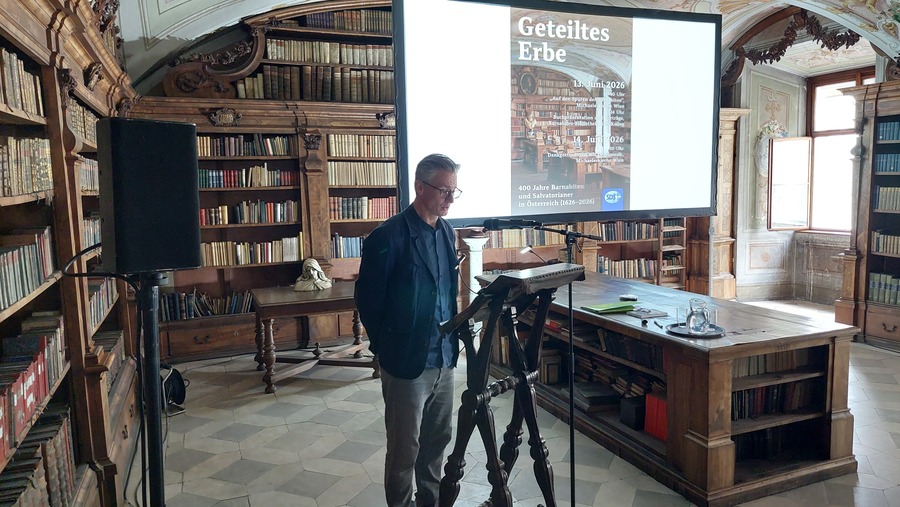
Martin Kolozs, a member of staff at the Provincial Archives and editor of the new book *Geteiltes Erbe* (Shared Heritage), opened the symposium in the afternoon. (c) Salvatorianer/Robert Sonnleitner
The Barnabites’ architectural activities in Austria
The series of specialist lectures was opened by the art historian Prof. Richard Bösel. In his presentation, he focused on the Barnabite settlements in Austria and presented the latest research findings on the architectural history of the monasteries and churches they built and shaped. In doing so, he opened up new perspectives on the Order’s architectural and cultural heritage in Austria.
From Milan to Vienna: The Beginnings of the Barnabites in Austria
The Barnabites came to Vienna in 1626 on the initiative of Emperor Ferdinand II. Instead of establishing a foundation in Prague, as originally planned, they took over the parish of St Michael’s in front of the Hofburg. From there, St Michael’s College developed into their most important centre within the Habsburg Monarchy. Further branches were later established in Prague, Mistelbach, Mariahilf and Margarethen am Moos.

Prof. Richard Bösel gave a talk on the Barnabite settlements in Austria and presented new research findings on their architectural history. (c) Salvatorianer/rs
Bösel described how research into the architectural history of the Barnabites has made significant progress in recent decades thanks to previously little-noticed archival collections in Milan and Rome. Numerous plans and design drawings have been preserved there, providing new insights into the development of the Order’s Austrian houses.
New sources, new insights
Among the most significant finds is a set of plans for the Michaelerkolleg, dated 1663. It revealed that the court architects Filiberto Lucchese and Giovanni Pietro Tencalla were involved in the planning. This discovery also led to new insights into the development of Baroque architecture in Vienna.
Using designs for Mariahilf and Margarethen am Moos, Bösel also demonstrated how closely architecture, pastoral care and social representation were intertwined. The building projects reflect the significance attached to the Barnabites within the Habsburg Monarchy.

The new book *A Shared Heritage: 400 Years of the Barnabites and Salvatorians in Austria (1626–2026)* was presented to the public for the first time during the symposium in St Michael. The book can be purchased directly from the publisher, Martin Kolozs , or from the St Michael parish office (price: 20 Euros plus postage) (c) Salvatorianer
Architecture as an expression of pastoral care and presence
The lecture highlighted the contribution made by the Barnabites to Austria’s religious and cultural development. The newly published volume *Geteiltes Erbe* summarises the findings of this research and documents an important chapter in the shared history of the Order.
Against slander and defamation: The Nepomuk Brotherhood of Mistelbach
The veneration of Saint John of Nepomuk experienced a remarkable resurgence in the 18th century throughout the lands of the Habsburg Monarchy. One of the earliest and most significant associations of this kind was the St John of Nepomuk Brotherhood in Mistelbach, which was founded and supported by the Barnabites. The historian Benjamino Cantonati spoke about its history at the launch of the book *A Shared Heritage*.

Dr Benjamino Cantonati presented the history of the St John of Nepomuk Brotherhood in Mistelbach, founded by the Barnabites, and highlighted its significance for religious life in Lower Austria. (c) Salvatorianer/rs
A Saint Conquers Lower Austria
The brotherhood was founded in 1724, just a few years after the beatification of John of Nepomuk and before his canonisation in 1729. The Barnabites, who had been in charge of the parish of Mistelbach since the 17th century, were among the most committed promoters of his veneration. The Bohemian martyr was regarded as a model of loyalty, discretion and strength of conscience. His cult was deliberately strengthened during the Counter-Reformation and spread rapidly beyond the borders of Bohemia.
Mistelbach played a special role in this regard. The brotherhood there was one of the first of its kind in Lower Austria and quickly developed into one of the wealthiest. Unlike in many other places, numerous documents have been preserved in Mistelbach, including account books, contracts and ecclesiastical authorisations. Today, these offer a rare insight into the religious life of a Baroque parish.
The good reputation of one’s neighbour as a spiritual programme
At the heart of the brotherhood lay a concern that remains relevant to this day: the protection of one’s good reputation. The statutes obliged members to avoid slander, defamation and libel. This idea was derived directly from the legend of Nepomuk. John of Nepomuk was regarded as the priest who upheld the seal of confession even under torture and lost his life as a result. The Barnabites made this message the spiritual core of the brotherhood.
 The symposium Shared Heritage attracted considerable interest and brought together numerous guests from the Church, academia, and the wider public. (c) Salvatorianer/rs
The veneration was not limited to prayers and devotional practices. The confraternity played a significant role in shaping the public life of the town. Solemn services were celebrated with music, trumpets, and kettledrums. Processions passed through the marketplace and the surrounding villages. Banners, confraternity staffs, and a gilded statue of St. John of Nepomuk made the devotion highly visible. A dedicated altar to St. John of Nepomuk was established in the parish church, and later a reliquary containing relics of the saint was added, which was ceremonially brought to Mistelbach in 1736.
The Barnabites succeeded in combining religious practice with community life. Membership was open to women and men from all social backgrounds. Nobles, craftsmen, clergy, and townspeople joined together within the same confraternity. Particularly noteworthy was the close network connecting the confraternity with the regional nobility and clergy, which contributed significantly to its success.
Baroque Flourishing and an Abrupt End
For decades, St. John of Nepomuk was among the most venerated saints in Mistelbach. Few other saints were so prominently represented throughout the liturgical year with numerous services, processions, and commemorative celebrations. The sources reveal how carefully the Barnabites cultivated this devotion and how profoundly they influenced the religious life of the region.
The end came with the reforms of Emperor Joseph II. In 1784, the confraternities were dissolved and their assets transferred to the Religious Fund. The processions disappeared, the festive celebrations were discontinued, and many furnishings and devotional objects were lost. Today, only a few traces of the once-thriving confraternity remain. These include the statue of St. John of Nepomuk and documents preserved in the monastery archives, which recall a period when devotion to the saint left a lasting mark on the religious life of Mistelbach.
The lecture highlighted the important contribution made by the Barnabites to the religious culture of Lower Austria. The history of the Confraternity of St. John of Nepomuk is more than a chapter in local devotional history. It also demonstrates how religious orders helped shape faith, community life, and society over generations.
Between Renewal and Farewell: What the History of the Barnabites in Austria Teaches Us
During the presentation of the book Shared Heritage, Fr. Filippo Lovison, B., a Barnabite and Professor of History and Ecclesiastical Cultural Heritage at the Pontifical Gregorian University in Rome, focused on a little-known chapter in the history of the order: the fate of the Austrian Province of the Barnabites. His lecture was both a historical investigation and an invitation to engage in critical remembrance.
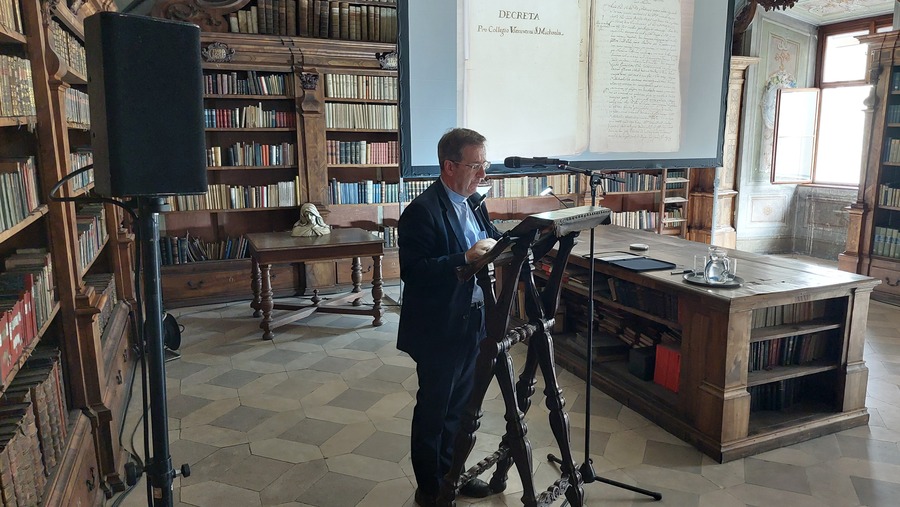
Fr. Filippo Lovison, B., spoke about the history of the Austrian Province of the Barnabites and its transition to the Salvatorians. (c) Salvatorianer/rs
The Long Road to the End of a Province
Although the Barnabites shaped ecclesiastical life in Vienna, Mistelbach, and other parts of Lower Austria for almost three centuries, their history has so far only been partially researched. Lovison referred to extensive archival sources preserved in the Order’s General Archive in Rome, many of which remain largely unexplored. These documents record both the development of the Austrian foundations and their decline, culminating in the dissolution of the province in 1922.
At the center of his lecture was a question that continued to occupy the leadership of the Order for decades after the suppression of the province: Should the Barnabites return to Austria, or should the former foundations be abandoned permanently? This dilemma ran like a common thread throughout the history of the former province.
According to Lovison, the crisis began as early as the reign of Emperor Joseph II. State reforms fundamentally altered the life of religious orders. Community life became increasingly difficult to maintain, and many priests served in isolated parishes. Internal reports from the 1920s describe a gradual erosion of communal religious life and growing financial difficulties, both of which ultimately contributed to the collapse of the province.
The Salvatorians Assume Responsibility
The dissolution of the province also marked the beginning of a new chapter. In 1923, the Salvatorians assumed pastoral responsibility for the former Barnabite houses under the terms of an agreement. These included St. Michael and Mariahilf in Vienna, as well as St. Martin in Mistelbach. What was initially intended as a temporary arrangement developed into a lasting commitment. The Salvatorians continued the pastoral work and shaped the development of these communities for generations.
When the Barnabites reconsidered a return to Austria in the 1950s, it became clear how profoundly the situation had changed. The pastoral structures established by the Salvatorians had become diverse and vibrant. At the same time, the Barnabites faced a shortage of personnel and vocations. As a result, the idea of returning remained only a possibility and was never realized.
Remembering as a Mission for the Future
Particularly striking was Lovison’s emphasis on the importance of memory. Historical documents, libraries, and archives, he argued, are far more than relics of the past. They preserve the experiences, achievements, and mistakes of previous generations. For this reason, the history of the Austrian Barnabites is not merely a story of decline, but also a valuable source for understanding the challenges faced by the Church and religious communities today.
In closing, Lovison combined his gratitude to the Salvatorians with an invitation to engage in a shared act of remembrance. The cooperation between the two communities has helped keep an important chapter of Church history alive. Reflecting on this past, he suggested, can help shape the future with greater awareness. In this lies the enduring relevance of the “shared heritage.”
The book Shared Heritage: 400 Years of Barnabites and Salvatorians in Austria (1626–2026) can be obtained directly from the editor, Martin Kolozs, or through the parish office of St. Michael (price: €20 plus postage).